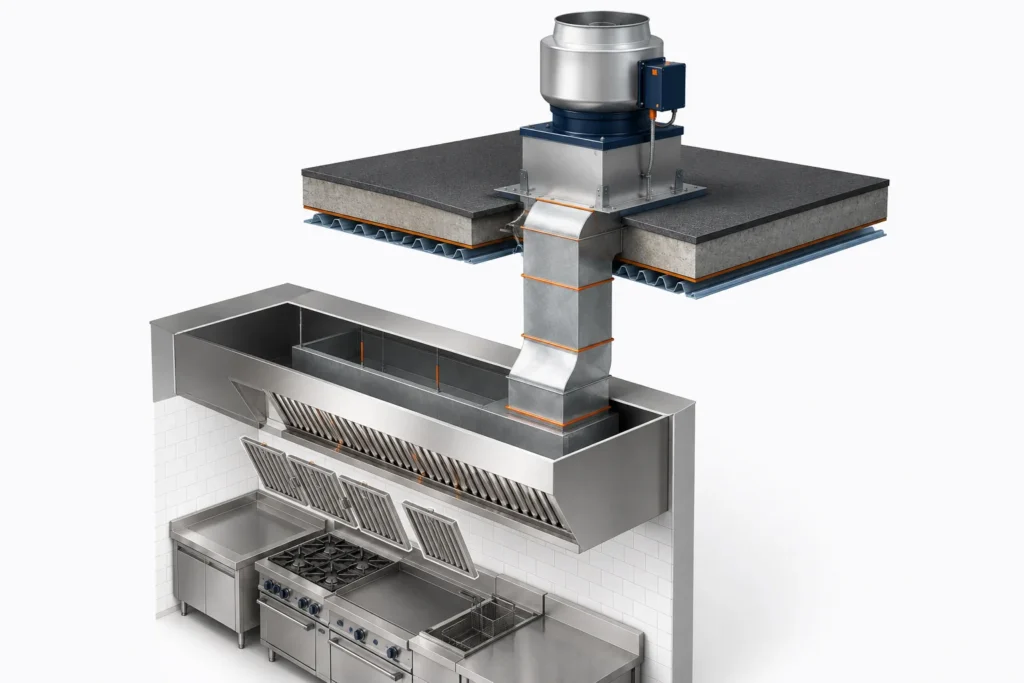
Duct cleaning and hood cleaning are two parts of the same job, not competing services. “Hood cleaning” usually means scrubbing the visible canopy, the grease filters and the plenum behind them; “duct cleaning” means clearing grease out of the hidden ductwork run and the exhaust fan. A proper commercial kitchen clean covers both — the entire exhaust system from hood to roof — because grease left anywhere in the run is a fire risk.
If you run a restaurant, hotel kitchen, cafeteria or cloud kitchen in the UAE, this distinction matters more than it sounds. Booking the wrong scope leaves grease where you cannot see it, and that is exactly where kitchen fires start and where inspectors look. Here is what each term actually covers, why “hood only” is never enough, and what you should be paying for.
The anatomy of a commercial kitchen exhaust system
Before you can tell the two services apart, it helps to picture the system as one continuous path that grease-laden air travels from your cooking line to the roof. Every stage collects grease, and every stage needs cleaning.
- Hood / canopy — the stainless steel housing above your cooking line that captures rising smoke, steam and grease vapour.
- Grease filters (baffle filters) — the angled metal filters that trap grease droplets before air enters the system.
- Plenum — the chamber behind and above the filters where grease accumulates heavily and out of sight.
- Ductwork — the often-long, hidden run of metal ducting that carries the air upward and across the building.
- Exhaust fan — the motor and blades (usually on the roof) that pull air through the whole system; grease cakes onto the blades and housing.
- Roof discharge point — where the cleaned air finally exits the building.
The key thing to understand: grease does not stop at the filter. It travels with the air and settles along the entire run — including the parts you will never see during a normal day.
What “hood cleaning” covers
When most kitchen managers say “hood cleaning,” they mean the front, visible end of the system. A standard hood clean addresses:
- The canopy surfaces, inside and out
- The grease filters (degreased or replaced)
- The plenum chamber directly behind the filters
- Visible drip trays and grease cups
This is the part of the system your staff can see and reach. It is the most obvious source of grease build-up, and a clean hood looks reassuring. But it is only the first metre or two of a system that may run many metres up and across your building. A spotless canopy tells you nothing about what is sitting in the ductwork above it.
What “duct cleaning” covers
Duct cleaning addresses the hidden part of the system — the ductwork run and the exhaust fan. This is the work that requires access panels, specialist tools and trained technicians, because the grease here is out of sight and harder to reach. A proper duct clean covers:
- The full length of the horizontal and vertical ductwork
- Bends, joints and any sections where grease collects and hardens
- The exhaust fan blades, housing and motor area
- The roof discharge point
Grease in the ducts is the most dangerous kind because you cannot inspect it casually and it builds up unnoticed over weeks and months. Hardened grease lining a duct is effectively fuel waiting along the path a fire would travel.
Why “hood only” is not enough
This is the single most important point for any UAE operator. Cleaning only the visible hood while leaving the ducts untouched gives a false sense of safety — the kitchen looks clean, but the real hazard is still in place.
There are two consequences. First, fire risk: grease is flammable, and a duct lined with hardened grease can turn a small flare-up at the cooking line into a fire that spreads rapidly through the ductwork and into the building structure. Second, compliance failure: under the UAE Fire and Life Safety Code, the kitchen exhaust system must be kept clean and maintained. Dubai Civil Defence expects the full exhaust system to be cleaned and documented — not just the canopy. A partial clean can mean a failed inspection, even if your hood gleams. For more on the safety side, see our kitchen hood fire prevention guide.
Hood cleaning vs duct cleaning at a glance
| Aspect | Hood cleaning | Duct cleaning |
|---|---|---|
| What’s covered | Visible canopy, grease filters, plenum, drip trays | Full ductwork run, bends and joints, exhaust fan, roof discharge |
| Visibility | Visible and reachable by staff | Hidden; needs access panels and specialist tools |
| Why it matters | Removes the obvious grease at the source; keeps filters working | Removes the hidden grease that fuels and spreads kitchen fires |
| Risk if skipped | Reduced extraction, smoke and odour, grease dripping | Serious fire spread risk and failed Civil Defence inspection |
| Frequency | Tied to cooking volume — see below | Tied to cooking volume — see below |
What a complete, professional service includes
The honest answer to “which one do I need?” is: you need the whole system cleaned, every time. A reputable provider does not sell “hood cleaning” and “duct cleaning” as separate ways to cut corners — they treat the exhaust system as one job. A complete service covers:
- Hood and canopy, inside and out
- Grease filters, degreased or replaced
- The plenum chamber
- The full ductwork run, end to end
- The exhaust fan and motor area
- The roof discharge point
The work follows the methodology of the internationally recognised NFPA-96 standard, which sets out how commercial kitchen exhaust systems should be cleaned and maintained. After the job, you receive a cleaning certificate and report documenting what was cleaned — recognised by Dubai Civil Defence and Dubai Municipality, and exactly the proof an inspector or insurer will ask for. See our full range of services for what each visit includes.
Which one do you actually need?
If you take one thing away: do not think in terms of “hood or duct.” Think in terms of the whole exhaust system. The hood is the visible tip; the ducts and fan are where the hidden risk lives. Booking a clean that stops at the filters leaves the most dangerous grease exactly where it is.
The right question is not “which service do I buy?” but “is my provider cleaning the entire system and giving me a certificate to prove it?” If the answer is no, you are exposed on both fire safety and compliance.
How it’s priced and scheduled
Pricing depends on the size of your kitchen, the length and layout of your ductwork, the number of exhaust fans, and how heavy the grease build-up is. A small café with a short duct run is a very different job from a hotel kitchen with a long, multi-bend system and rooftop fans — which is why a proper quote follows a site assessment rather than a flat phone price. For a full breakdown, read how much kitchen hood cleaning costs in Dubai.
Scheduling is driven by how much you cook:
- Monthly — high-volume kitchens with heavy frying, charcoal or wok cooking running long hours.
- Quarterly — standard restaurants and busy cafés with moderate cooking volume.
- Roughly every six months — low-volume kitchens, small operations and seasonal venues.
Setting a fixed cleaning schedule keeps you continuously compliant and means the grease never builds up to a dangerous level in the first place.
FAQ
Is hood cleaning the same as duct cleaning?
No. Hood cleaning covers the visible canopy, filters and plenum, while duct cleaning covers the hidden ductwork run and exhaust fan. They are two parts of one job — a complete service cleans the entire exhaust system, not just the visible hood.
Do I really need the ducts cleaned if my hood looks clean?
Yes. A clean canopy tells you nothing about the hidden ductwork, where grease quietly accumulates. That hidden grease is the main fire-spread risk and is exactly what Dubai Civil Defence expects to be cleaned and documented.
How often should the whole system be cleaned?
It depends on cooking volume: roughly monthly for high-volume kitchens, quarterly for standard restaurants, and around every six months for low-volume operations. A site assessment confirms the right interval and keeps you continuously compliant.
Book a complete exhaust system clean
Stop guessing whether you need “hood” or “duct” cleaning — get the whole system cleaned and certified in one visit, across all seven emirates. Call or WhatsApp us on +971585707110, or email contact@kitchenhoodcleaning.ae, and get in touch for a site assessment and quote.