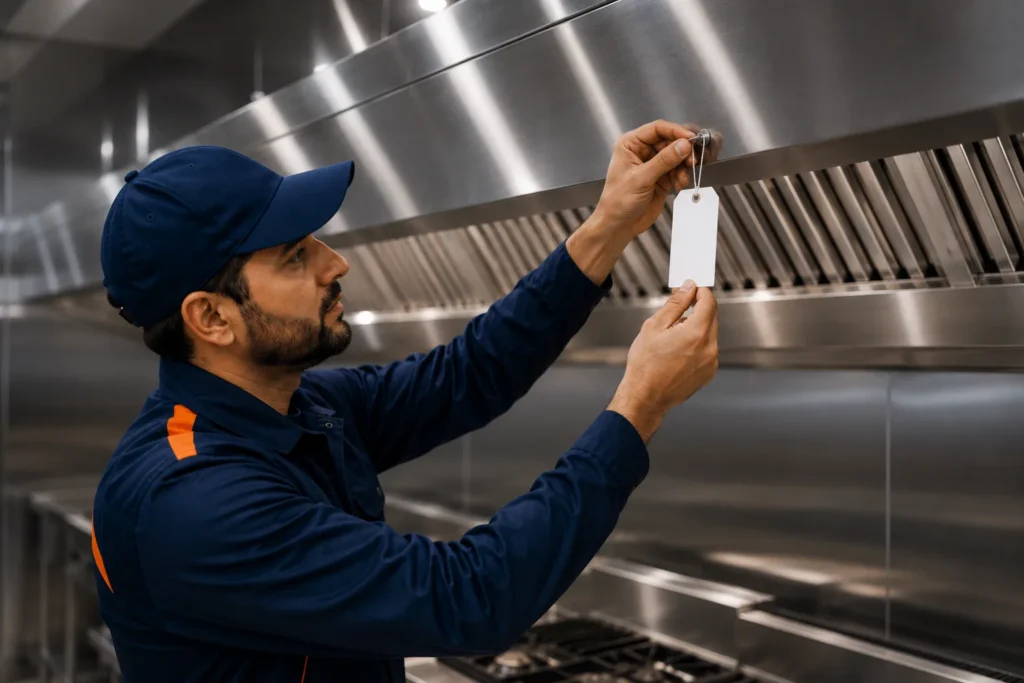
How often should you clean a commercial kitchen hood in Dubai? As a general rule, high-volume kitchens (heavy frying, charbroiling, wok, tandoor or 24-hour operations) need cleaning every month; standard restaurants with moderate cooking need it every three months; and low-volume kitchens such as cafés or light-cooking outlets are usually fine at roughly every six months. The exact frequency depends on how much you cook, what you cook, and how many hours your kitchen runs.
That single answer covers most outlets, but it is worth understanding the rule behind it. Getting your cleaning frequency right is not just about a tidy kitchen. In Dubai it is a fire-safety and legal requirement, and the right schedule protects your staff, your premises and your licence. This guide explains how to set the correct cadence for your specific kitchen and stay on the right side of Dubai Civil Defence.
Why Cleaning Frequency Matters
Every time you cook with oil or fat, grease-laden vapour rises into your hood, filters and ductwork. As that vapour cools, it condenses into a sticky, flammable layer. Grease is the core fuel for commercial kitchen fires, and the thicker it builds up, the more dangerous your extraction system becomes. A small flare-up at the cooktop can travel straight into a grease-coated duct and turn into a serious structural fire within seconds.
Cleaning frequency matters because grease accumulates continuously. The busier your kitchen and the heavier your cooking, the faster the danger builds. A schedule that is too infrequent lets grease reach hazardous levels between visits; the correct frequency keeps the system below that threshold at all times.
There is also a compliance dimension. Commercial kitchen exhaust cleaning is required under the UAE Fire and Life Safety Code, and Dubai Civil Defence inspects commercial kitchens and expects clean, well-documented extraction systems. Non-compliance can expose your business to fines or even closure. Our work follows NFPA-96, the international standard for commercial kitchen ventilation, which is the recognised methodology for cleaning these systems to a defensible standard. You can read more about our full cleaning services and what each visit includes.
The Three Cooking-Volume Tiers Explained
NFPA-96 frames inspection and cleaning frequency around cooking volume rather than a fixed calendar date for every kitchen. In plain language, the more grease your cooking produces, the more often the system must be cleaned. Best practice in Dubai, aligned with Civil Defence expectations, sorts kitchens into three broad tiers.
High-Volume Kitchens — Monthly
If your kitchen runs heavy frying, charbroiling, wok cooking, a tandoor or operates around the clock, you are a high-volume operation. These kitchens produce the most grease in the shortest time. Hotels, large banquet kitchens and 24-hour outlets typically fall here and should plan on a monthly hood and duct cleaning cycle to stay safe and compliant.
Standard / Moderate Kitchens — Quarterly
Most mid-sized restaurants serving a normal lunch and dinner service sit in the moderate tier. With a regular mix of grilling, sautéing and some frying, a full cleaning every three months keeps grease at safe levels. Quarterly is the most common recommendation we issue for typical Dubai restaurants.
Low-Volume Kitchens — Roughly Every Six Months
Cafés, sandwich bars, bakeries and outlets that do mostly light cooking generate far less grease. These kitchens are usually well served by a cleaning roughly every six months. That said, even a low-volume kitchen still needs documented servicing — six months is the maximum sensible gap, not a reason to skip inspection.
Recommended Frequency by Kitchen Type
| Kitchen Type | Cooking Profile | Recommended Cleaning Frequency |
|---|---|---|
| Hotels & 24-hour kitchens | Continuous, high-volume cooking | Monthly |
| Heavy frying / charbroil / wok / tandoor | High grease output | Monthly |
| Standard restaurants | Moderate grilling, sautéing, some frying | Every 3 months (quarterly) |
| Cafés, bakeries, light cooking | Low grease output | Roughly every 6 months |
Filters vs Hood vs Full Duct Cleaning
An exhaust system is not cleaned all at once on the same cadence. Different parts foul at different rates, so a sensible schedule treats them separately.
- Filters (baffle filters): These trap grease first and clog fastest. They need the most frequent attention — many busy kitchens degrease their filters weekly or even daily as part of in-house cleaning, supplementing the professional service.
- The hood and canopy: The visible hood and plenum collect grease steadily and are cleaned during each professional service, on the monthly, quarterly or six-monthly cycle that matches your volume tier.
- Full ductwork and the exhaust fan: The horizontal and vertical duct runs and the rooftop fan are the hardest to reach and the most dangerous when neglected, because a duct fire is hard to fight. These are cleaned thoroughly on your professional schedule and are the heart of an NFPA-96-aligned service.
In short: filters need the most frequent cleaning, while the full ductwork sets the cadence for the formal, documented service that Civil Defence wants to see.
Signs You Are Overdue for a Cleaning
Your schedule is the baseline, but your kitchen will also tell you when grease is building too fast. Watch for these warning signs:
- Visible grease dripping from the hood, filters or seams
- Smoke lingering in the kitchen because the extraction is no longer pulling efficiently
- Strong, stale grease odours even when you are not cooking
- Filters that look saturated or clog again within days of cleaning
- Reduced airflow at the canopy or a labouring exhaust fan
- It has simply been longer than your recommended interval since the last documented service
If you notice any of these, do not wait for the next scheduled visit — bring the cleaning forward.
What Inspectors Look For
Dubai Civil Defence inspects commercial kitchens and expects to see a system that is both clean and documented. After each professional service, a cleaning certificate or report is issued — recognised by Dubai Civil Defence and Dubai Municipality — confirming the work was done to standard. Inspectors typically check that grease is not built up to hazardous levels on filters, hood and duct, that the extraction system is functioning, and crucially that you can produce records showing a regular cleaning history. A clean hood with no paperwork is hard to defend; the documented certificate is what proves ongoing compliance. Keeping these reports on file is as important as the cleaning itself.
How to Set a Cleaning Schedule
Setting the right schedule comes down to four drivers: your cooking volume, the type of cooking and oil you use, your hours of operation, and your fuel and equipment type. Start by honestly placing your kitchen in one of the three tiers, then book a recurring service at that interval. Most operators find it easiest to put the cleaning on a standing schedule — monthly, quarterly or six-monthly — so it never slips.
From there, supplement with daily or weekly in-house filter degreasing, watch for the overdue signs above, and keep every cleaning certificate on file for inspections. If you are unsure which tier you fall into, an assessment of your kitchen and cooking profile will pin it down. Costs vary with kitchen size and frequency — see our guide on how much kitchen hood cleaning costs in Dubai. We serve restaurants and hotels across Dubai and can build a compliant schedule around your operation.
FAQ
How often does Dubai Civil Defence require kitchen hood cleaning?
There is no single fixed interval for every kitchen. Dubai Civil Defence expects extraction systems to be kept clean and documented in line with the UAE Fire and Life Safety Code and NFPA-96 methodology. In practice this means monthly for high-volume kitchens, quarterly for standard restaurants and roughly six-monthly for low-volume outlets.
Is cleaning the filters enough, or do I need the full duct cleaned?
Filter cleaning alone is not enough. Filters foul fastest and should be degreased frequently in-house, but grease still travels into the hood, ductwork and exhaust fan. The full duct must be professionally cleaned on your scheduled cycle — that is what removes the hidden fire fuel and what your compliance certificate covers.
What happens if I do not clean my kitchen hood regularly?
Two risks. First, fire: built-up grease in the hood and duct is highly flammable and is the leading fuel for commercial kitchen fires. Second, compliance: without clean, documented systems you risk fines or closure during a Dubai Civil Defence inspection. Regular, certificated cleaning protects against both.
Book Your Kitchen Hood Cleaning Today
Not sure how often your kitchen needs cleaning, or due for a service? Our team will assess your cooking profile, recommend the right schedule and issue a compliance certificate after every visit. Call or WhatsApp us on +971585707110, email contact@kitchenhoodcleaning.ae, or get in touch for a fast quote anywhere in Dubai.