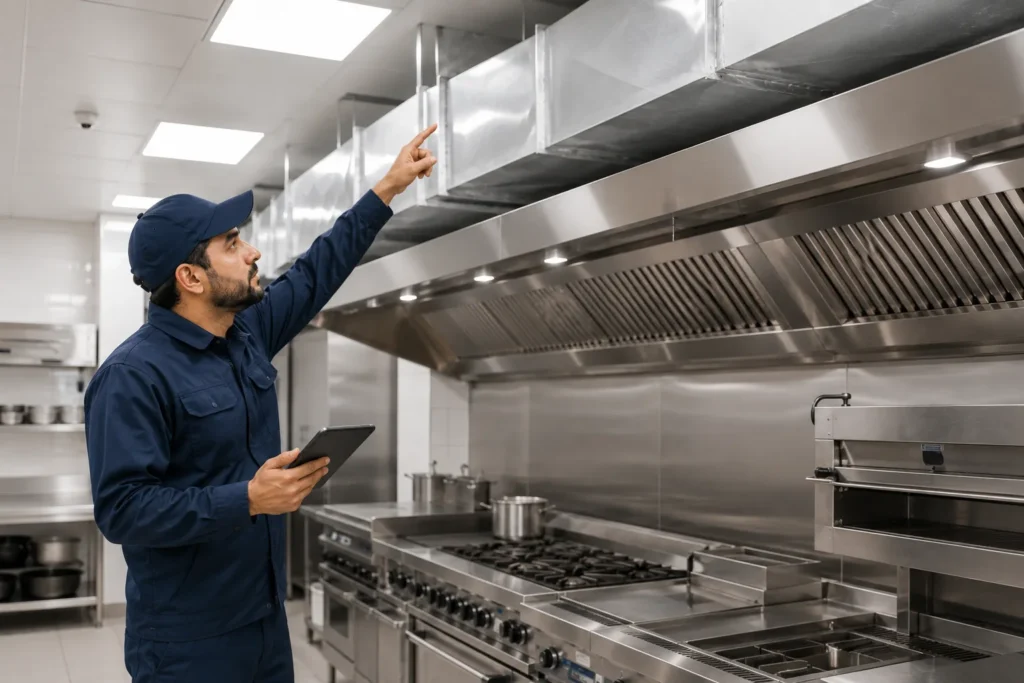
NFPA 96, the “Standard for Ventilation Control and Fire Protection of Commercial Cooking Operations,” is the widely-referenced US and international standard governing how commercial kitchen exhaust systems are designed, maintained, inspected and cleaned to prevent grease fires. In the UAE, NFPA 96 is not law in its own right, but it informs and aligns closely with the UAE Fire and Life Safety Code, and Dubai Civil Defence expects restaurants to keep their exhaust systems clean and properly documented. For restaurant owners, understanding NFPA 96 is the clearest way to grasp what “fire-safe” actually means for your kitchen.
What NFPA 96 Actually Covers
NFPA 96 takes a whole-system view of the commercial cooking exhaust. Rather than focusing on a single component, it addresses every part of the path that grease-laden vapour travels from the cooking line to the outside air. The standard covers:
- Exhaust hoods — the canopy that captures heat, smoke and grease vapour above your cooking equipment.
- Grease-removal devices — the baffle filters that trap grease before it enters the ductwork.
- Ductwork — the concealed runs that carry vapour from the hood to the fan, where grease silently accumulates.
- Exhaust fans — the rooftop or in-line units that draw vapour out of the building.
- Fire-suppression systems — the wet-chemical systems designed to extinguish a fire at the cooking line and within the hood.
- Regular inspection and cleaning — the requirement that the entire exhaust system be inspected and cleaned by qualified persons at intervals suited to the cooking volume.
The underlying principle is simple: grease is fuel. Every cooking operation deposits a film of grease throughout the exhaust system, and once that film builds up, a single flare-up at the cooktop can travel into the ductwork and become a serious structural fire. NFPA 96 exists to break that chain. For a fuller explanation of how grease fires start and how they are prevented, see our kitchen hood fire prevention guide.
How NFPA 96 Maps to the UAE Fire and Life Safety Code
In the UAE, commercial kitchen fire safety is governed by the UAE Fire and Life Safety Code, with enforcement carried out by the relevant civil defence authority — most prominently Dubai Civil Defence in Dubai. These local requirements draw heavily on internationally established fire-protection standards, and NFPA-style provisions inform much of the best practice that authorities expect to see.
In practical terms, that means a UAE restaurant operating to NFPA 96 principles is usually well-positioned to meet local expectations. Dubai Civil Defence expects commercial kitchens to maintain clean exhaust systems, to keep those systems serviceable, and — importantly — to be able to prove it with documentation. The cleaning report or certificate issued after a professional service, recognised by Dubai Civil Defence and Dubai Municipality, is the evidence that ties your day-to-day operations to the code.
It is worth stating clearly: NFPA 96 is the international standard our cleaning work follows. It is not a licence or certificate that any company “holds.” When a service provider tells you they clean to NFPA 96, they mean their method and scope align with the standard’s expectations — not that they have been awarded NFPA accreditation.
The Cleaning-Frequency-by-Volume Principle
One of the most useful ideas in NFPA 96 is that cleaning frequency should scale with how much — and what — you cook. A high-volume charcoal grill house produces far more grease than a small café serving toasted sandwiches, so applying a single fixed schedule to both makes little sense. The standard groups operations broadly by cooking volume:
- High-volume cooking (such as 24-hour operations, charcoal or wood-fired cooking, and busy grills) — typically monthly cleaning.
- Standard / moderate-volume cooking (most full-service restaurants) — typically quarterly cleaning.
- Low-volume cooking (light cooking, seasonal or low-traffic kitchens) — typically around every six months.
These intervals are guidance, not a rigid rule. A kitchen that produces heavy grease will need more frequent attention regardless of which category it nominally falls into, and the only reliable way to judge is by inspecting the system. For a detailed look at how often UAE kitchens should clean their hoods, read our guide on how often to clean a commercial kitchen hood in Dubai.
What “Compliant” Looks Like in Practice
Compliance is not a single action — it is a maintained state across the whole exhaust system. In practice, a kitchen that is in good standing will show the following:
- Filters — grease baffle filters cleaned regularly and free of caked grease, so they actually capture vapour rather than letting it pass into the duct.
- Ductwork — the full duct run cleaned down to bare metal where accessible, with no thick grease deposits lining the interior. This is the area most often neglected because it is out of sight.
- Exhaust fan — the fan blades and housing cleaned so the unit moves air efficiently and grease does not accumulate at the discharge point.
- Fire-suppression system — a serviceable, in-date wet-chemical suppression system with nozzles correctly positioned and unobstructed.
- Documentation — dated records of each clean, photographs where appropriate, and a cleaning certificate or report kept on file and ready for inspection.
Professional exhaust cleaning addresses all of these together, because cleaning the hood while leaving the duct full of grease leaves the most dangerous part of the system untouched. You can see the full scope of what a thorough service includes on our services page.
The Role of the Cleaning Certificate in Inspections
The cleaning certificate is where good maintenance becomes provable compliance. After a professional clean, a report or certificate is issued documenting what was cleaned, when, and to what standard. In the UAE this document — recognised by Dubai Civil Defence and Dubai Municipality — is the record an inspector will ask to see.
Without it, even a genuinely clean kitchen can struggle during an inspection, because there is no evidence of when the system was last serviced or how often it is maintained. The certificate closes that gap. It demonstrates a consistent maintenance schedule, supports your insurance position, and signals that the business takes fire safety seriously. Keeping a running file of dated certificates is one of the simplest and most effective things an owner can do.
Owner and Facilities Manager Responsibilities
Responsibility for exhaust-system fire safety sits firmly with the restaurant owner or facilities manager — not with the cleaning contractor alone. Your core duties are to:
- Arrange professional exhaust cleaning at a frequency suited to your cooking volume.
- Keep the fire-suppression system serviced and in date.
- Retain dated cleaning certificates and inspection records, ready to produce on request.
- Ensure access to the full system, including concealed ductwork, so cleaning can be done properly.
- Act promptly when an inspection identifies grease build-up or a deficiency.
Delegating the work does not delegate the accountability. If an inspector finds a heavily greased duct or an expired suppression service, it is the operator who answers for it.
Consequences of Non-Compliance
The risks of neglecting exhaust-system maintenance fall into two categories. The first is safety: a grease-laden duct is the classic ignition path for a commercial kitchen fire, and such fires spread fast, cause severe property damage, and put staff and customers at risk. The second is regulatory and commercial: failing an inspection can lead to enforcement action, may affect your insurance cover in the event of a claim, and — at worst — can disrupt your ability to trade. A clean, well-documented system protects the business on every front, which is precisely why NFPA 96 principles are worth taking seriously even though the standard itself is not UAE law.
FAQ
Is NFPA 96 a legal requirement in the UAE?
No. NFPA 96 is an internationally referenced standard, not UAE law. However, it closely informs the UAE Fire and Life Safety Code, and Dubai Civil Defence expects clean, well-documented exhaust systems. Following NFPA 96 principles is the practical way to meet those local expectations.
How often should my kitchen exhaust system be cleaned?
It depends on cooking volume. High-volume kitchens are typically cleaned monthly, standard restaurants quarterly, and low-volume kitchens around every six months. These are guidelines — heavy grease producers may need more frequent service. A professional inspection is the most reliable way to set your schedule.
Do I get a certificate after cleaning?
Yes. After a professional clean, a cleaning certificate or report — recognised by Dubai Civil Defence and Dubai Municipality — is issued. It documents what was cleaned and when, and is the evidence inspectors ask to see. Keep a dated file of these certificates for compliance and insurance purposes.
Book a Compliant Kitchen Exhaust Clean Across the UAE
Keep your commercial kitchen safe, inspection-ready and aligned with NFPA 96 best practice. Our team cleans hoods, filters, ductwork and exhaust fans across all seven emirates and issues a recognised cleaning certificate after every service. Call or WhatsApp us on +971585707110, email contact@kitchenhoodcleaning.ae, or get in touch here to schedule your clean.