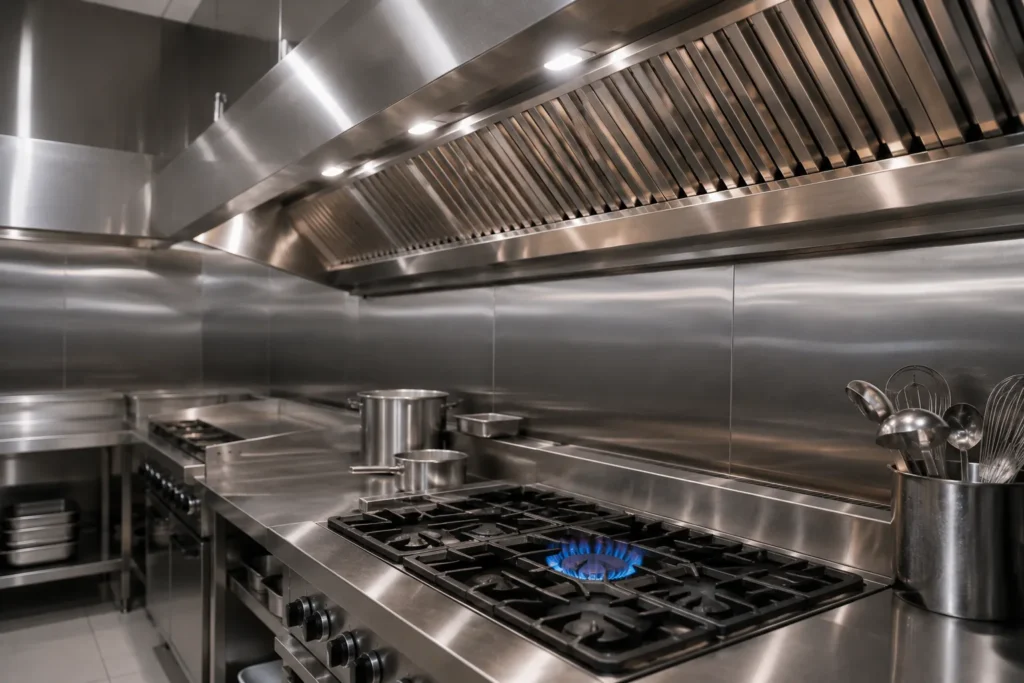
Preventing a kitchen hood fire comes down to one thing: not letting grease build up. Keep your exhaust hood, filters and ductwork professionally cleaned on a regular schedule, maintain working grease filters and a serviced fire-suppression system, and train staff to keep cooking surfaces and the hood area clean. Grease is the fuel; remove it consistently and a flare-up has nothing to spread to.
Across UAE restaurants, the most common serious kitchen fire is not a chip-pan accident that stays at the stove. It is a small flare-up that travels into a grease-coated exhaust system and turns into a hidden, fast-moving duct fire. This guide explains exactly how those fires start, which equipment puts you most at risk, and the practical prevention routine that keeps your Dubai kitchen safe and compliant.
How Kitchen Exhaust Fires Actually Start: The Grease Chain
Every commercial kitchen fire that involves the hood follows the same chain. When you cook, especially with oil and high heat, tiny droplets of grease vaporise and rise into the exhaust hood. The grease filters catch a portion of it, but the rest condenses and coats the inside of the hood, the plenum, and the entire run of ductwork all the way to the rooftop exhaust fan.
That accumulated grease is the primary fuel for a commercial kitchen fire. It is flammable, it is everywhere the smoke travels, and it is out of sight. All it needs is an ignition source. A sudden flare-up from a fryer, a charbroiler flame, or a wok burst can send flame straight up into the hood. If the hood and ducts are coated in grease, that flame ignites the deposits and races through the ductwork, often spreading to the roof and adjacent areas faster than staff can react.
This is why hood fires are so dangerous: the fire is travelling inside a sealed metal duct where you cannot see it, fight it easily, or stop it. Prevention is overwhelmingly cheaper and safer than response. Break the grease chain and the fire has nothing to feed on.
The High-Risk Equipment in Your Kitchen
Not all cooking equipment carries the same fire risk. The appliances that produce the most grease vapour and the most direct flame contact with the hood deserve the closest attention.
Deep Fryers
Fryers hold large volumes of hot oil and produce heavy grease-laden vapour. An oil overheat or boil-over can ignite, and the rising flame reaches straight into the hood. Fryers should sit under good suppression coverage and never be operated with a dirty hood above them.
Charbroilers and Grills
Charbroilers combine open flame with dripping fat. The fat drips, flares, and sends grease and flame upward continuously. They are among the heaviest grease producers and a frequent ignition point in busy kitchens.
Woks and High-Heat Ranges
Wok cooking and high-heat ranges, common across Asian, Indian and continental restaurants in Dubai, create intense bursts of flame and aerosolised oil. The rapid flaring is exactly the kind of ignition source that can light grease-laden ducts.
Tandoor Ovens
Tandoors run at very high temperatures with open charcoal or gas flame. They produce sustained heat and grease vapour, and the combination of an open fire directly beneath the exhaust makes a clean hood and duct essential.
The Fire Prevention Checklist
Fire prevention in a commercial kitchen is a routine, not a one-off task. Use this checklist as your standing operating procedure:
- Schedule regular professional exhaust cleaning. Match the frequency to your cooking volume: monthly for high-volume operations (heavy frying, charbroiling, 24-hour kitchens), quarterly for standard-volume restaurants, and roughly every six months for low-volume kitchens. See how often to clean your commercial kitchen hood in Dubai for detailed guidance.
- Clean and maintain grease filters. Working baffle filters are your first line of defence. Wash them frequently (often nightly in busy kitchens), replace damaged or warped filters, and never run the line with filters missing.
- Keep the fire-suppression system serviced. Your wet-chemical suppression system must be inspected and maintained on schedule, with nozzles unobstructed and aimed correctly. A suppression system only works if it is maintained and the fusible links are clean.
- Do not let grease build up anywhere. Wipe down hood surfaces, the canopy edge and surrounding walls daily. Grease that accumulates on surfaces is grease that can ignite.
- Train staff in safe habits. Never leave fryers or high-heat cooking unattended, keep combustibles away from cooking lines, know where the manual suppression pull station is, and report any flare-up immediately.
- Maintain good housekeeping. Clean floors, empty grease traps, manage oil disposal properly, and keep the cook line free of clutter so a small fire cannot spread.
- Keep your cleaning documentation current. Retain the cleaning certificate and report from each professional service for inspections.
What a Professional Clean Removes That DIY Can’t
Staff can and should wipe down accessible hood surfaces and wash filters daily. But that only reaches the small, visible portion of the system. The dangerous grease is in the parts you cannot reach: the plenum behind the filters, the full vertical and horizontal duct runs, and the exhaust fan housing on the roof.
A professional kitchen exhaust clean strips grease from the entire system, edge to edge, following the methodology of the international NFPA-96 standard. Technicians open access panels along the ductwork, scrape and degrease the internal surfaces, clean the fan blades and housing, and verify that the whole run is brought back to bare metal where reachable. This is the deep grease removal that breaks the fire chain. DIY wiping leaves the hidden fuel in place, which is exactly where duct fires start. Learn more about the standard on our NFPA-96 compliance guide for the UAE, or view the full scope on our services page.
The Compliance Angle: Civil Defence and Your Cleaning Certificate
Kitchen exhaust cleaning is not just good practice in the UAE; it is a regulatory requirement. The UAE Fire and Life Safety Code requires commercial kitchen exhaust systems to be kept clean and maintained. Dubai Civil Defence inspects food premises and expects to see exhaust systems that are clean and supported by documentation proving regular professional cleaning.
After a professional service, a cleaning certificate and report are issued. This documentation is recognised by Dubai Civil Defence and Dubai Municipality and serves as your proof of compliance during inspections, licence renewals and insurance reviews. Operating with a heavily grease-laden, undocumented system exposes you to fire risk, inspection failures, and potential liability if a fire occurs. Keeping a current certificate on file is the simplest way to demonstrate that your kitchen meets its obligations.
What to Do If You Suspect Grease Buildup
You do not need a smoke alarm to tell you a system is overdue. Watch for the warning signs: visible grease dripping from the hood or filters, a persistent greasy film on nearby walls and ceilings, sluggish extraction (smoke lingering over the cook line), stronger cooking odours than usual, or filters that look saturated even after cleaning. Any of these means grease has built up beyond what daily wiping can manage.
If you see them, do not wait for your next scheduled clean. Reduce the immediate risk by being extra vigilant at the fryer and charbroiler, ensure your suppression system is serviced, and arrange a professional inspection and clean as soon as possible. The cost of an unscheduled clean is trivial against the cost of a duct fire that closes your kitchen. If you are unsure when your system was last serviced, treat it as overdue and have it assessed.
FAQ
How often should a Dubai restaurant clean its kitchen hood to prevent fires?
It depends on cooking volume. High-volume kitchens with heavy frying or charbroiling should clean monthly, standard restaurants quarterly, and low-volume kitchens roughly every six months. Matching the schedule to your usage is what keeps grease from reaching dangerous levels.
Can my own staff clean the kitchen exhaust system instead of hiring a professional?
Staff should wipe hood surfaces and wash filters daily, but they cannot reach the plenum, ductwork and exhaust fan where the most dangerous grease accumulates. Only a professional clean strips the full system and produces the certificate Civil Defence expects.
Do I get proof of cleaning for Civil Defence inspections?
Yes. After each professional service a cleaning certificate and report are issued, recognised by Dubai Civil Defence and Dubai Municipality. Keep it on file as your proof of compliance for inspections, licence renewals and insurance.
Protect Your Kitchen Today
Grease buildup is preventable, and a clean exhaust system is the single most effective defence against a kitchen hood fire. Do not wait for an inspection notice or a flare-up to act. Our team cleans commercial kitchen hoods, filters and ductwork across all seven emirates to NFPA-96 methodology, with a recognised certificate issued on completion.
Call or WhatsApp us today on +971 58 570 7110, email contact@kitchenhoodcleaning.ae, or get in touch here to schedule your fire-prevention clean.